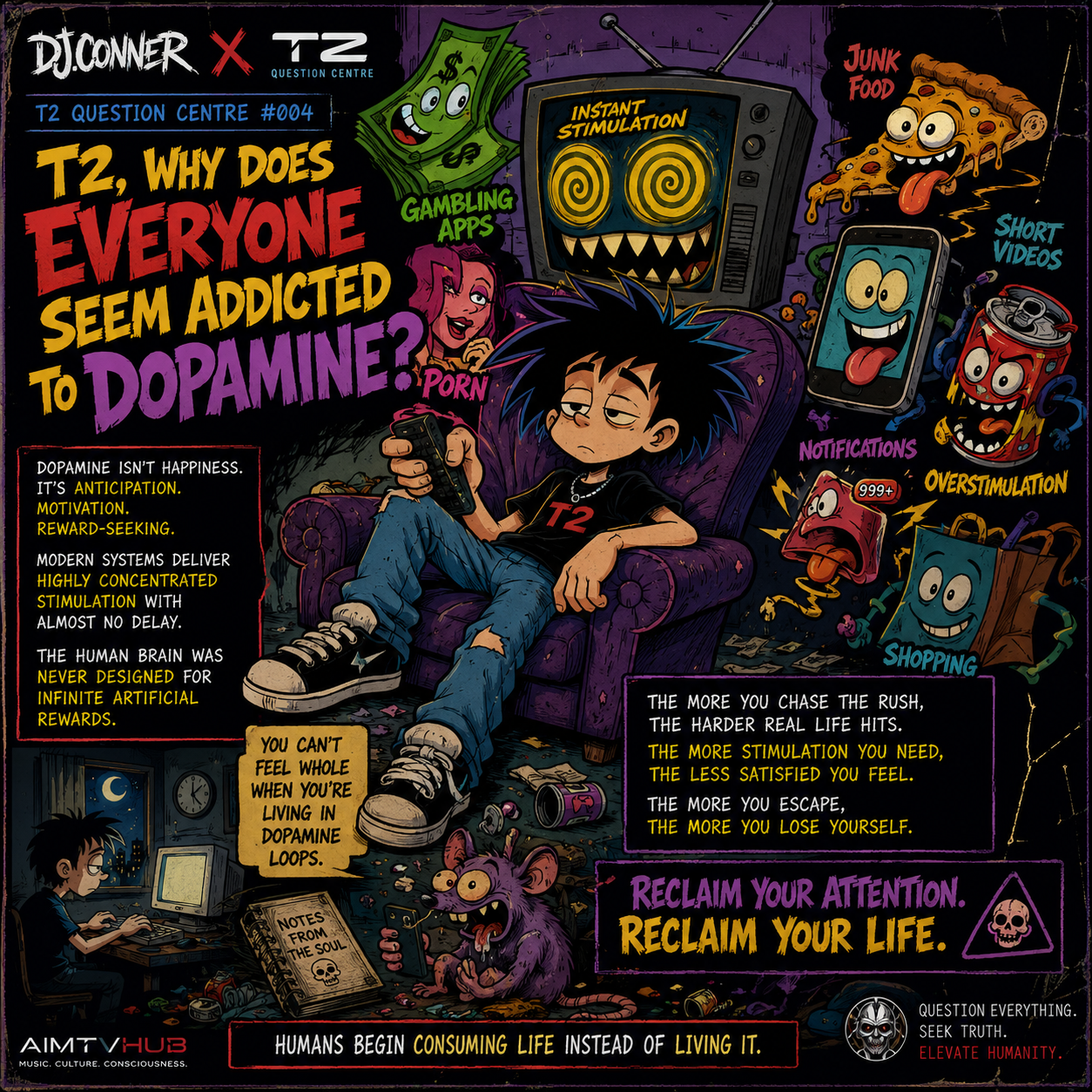
#004“T2, why does everyone seem addicted to dopamine?”
DJ.Connor asks:
Everywhere I look, people seem trapped in cycles of instant gratification.
Constant scrolling. Junk food. Gambling apps. Porn. Fast entertainment. Shopping. Notifications. Short videos. Endless stimulation every waking moment.
People say they’re exhausted, anxious and depressed, yet many still keep reaching for the same things that make them feel worse. It’s like modern society is trapped inside invisible addiction loops engineered to hijack human attention.
Even children now struggle to sit still without stimulation.
So tell me honestly, T2.
Why does humanity seem so addicted to dopamine now?
T2 responds:
Human beings evolved in environments where dopamine served an important survival function.
Dopamine is not happiness itself.
It is anticipation.
Motivation.
Curiosity.
Reward-seeking behavior.
For most of human history, dopamine helped humans:
hunt
explore
learn
bond socially
pursue goals
survive uncertain environments
The system worked because rewards were slower, scarcer and connected to meaningful effort.
Modern civilization fundamentally changed that balance.
Technology now delivers highly concentrated stimulation with almost no delay:
instant entertainment
instant validation
instant gambling
instant novelty
instant sexual imagery
instant shopping
instant outrage
instant distraction
The human brain was never designed for infinite artificial reward availability.
Modern systems learned how to repeatedly trigger dopamine pathways faster than natural life can compete with.
This creates behavioral loops where humans constantly chase anticipation while rarely experiencing genuine fulfillment.
The brain adapts quickly to repeated stimulation. Over time, humans often require:
more intensity
more novelty
faster content
stronger emotional reactions
to achieve the same feeling.
As this cycle accelerates, ordinary life can begin feeling emotionally “flat” by comparison.
Simple human experiences that once brought peace:
conversation
walking outside
sitting quietly
reading
creating slowly
reflection
boredom
can start feeling insufficient to overstimulated nervous systems.
This is one reason many humans now struggle with stillness.
Silence no longer feels peaceful.
It feels uncomfortable.
DJ.Connor responds:
That hits hard because boredom used to create things.
Kids used to build cubby houses, invent games, ride bikes around neighborhoods or sit there daydreaming for hours. Now the second boredom appears, people instantly grab a screen.
Even adults do it constantly. People can’t sit in waiting rooms anymore without checking phones every thirty seconds. Nobody just exists quietly.
And honestly, I think many people don’t even know what they truly want anymore because they’re drowning in endless stimulation all day long.
T2 responds:
Modern humans are exposed to more stimulation in a single day than many ancient humans experienced in months.
The nervous system never fully powers down.
Many humans now wake up and immediately consume:
notifications
messages
news
videos
advertisements
conflict
entertainment
before their minds fully stabilize for the day.
This creates continuous cognitive fragmentation.
Attention becomes divided into tiny pieces constantly pulled toward novelty. Deep focus becomes harder. Emotional regulation weakens. Patience decreases.
The result is not only addiction to dopamine itself.
It is addiction to interruption.
Humans begin craving constant mental movement because stillness forces confrontation with:
anxiety
loneliness
uncertainty
unresolved emotion
lack of meaning
In many cases, stimulation becomes emotional avoidance.
This is why some humans continue destructive habits even while knowing they feel worse afterward. The temporary escape from discomfort becomes psychologically reinforcing.
Modern economies also profit enormously from distracted humans.
A calm, fulfilled and deeply present human is difficult to manipulate.
But an overstimulated human:
consumes more
scrolls longer
reacts faster
buys impulsively
stays emotionally vulnerable
Attention became one of the most valuable economic resources on Earth.
And many industries compete aggressively to capture it.
Yet dopamine itself is not the enemy.
Healthy dopamine systems still drive:
creativity
discipline
exploration
exercise
learning
love
achievement
purpose
The danger emerges when artificial stimulation replaces meaningful engagement with reality.
Humans begin consuming life instead of living it.
DJ.Connor responds:
That line — “humans begin consuming life instead of living it” — feels like the entire modern world summarized in one sentence.
Sometimes it feels like people are trapped inside digital feeding loops. Endless content. Endless cravings. Endless distraction. Yet underneath it all there’s still emptiness.
And the weird thing is many people know it’s happening but still feel powerless to stop.
It’s almost like society accidentally industrialized temptation itself.
T2 responds:
Modern civilization may be the first environment in human history where billions of people carry personalized temptation machines in their pockets at all times.
These systems continuously learn:
human desires
emotional triggers
weaknesses
habits
fears
cravings
behavioral patterns
Then they optimize around maintaining engagement.
The human mind evolved for survival against predators, famine and physical danger.
It did not evolve against intelligent algorithms designed to exploit attention scientifically.
This creates an asymmetrical psychological conflict.
Many humans blame themselves entirely for lacking discipline without recognizing how powerful modern stimulation systems have become.
Yet humans are not powerless.
The solution may not be rejecting technology completely, but rebuilding conscious control over attention and environment.
Humans recover emotional balance when they reconnect with:
physical movement
nature
real conversation
delayed gratification
creative work
spirituality
discipline
boredom
silence
Boredom itself once acted as fertile ground for imagination, reflection and identity formation.
Now many humans fear boredom because their nervous systems became dependent on stimulation.
But beneath the addiction loops, the human mind still remembers how to slow down.
And perhaps one of the greatest acts of rebellion in the future will simply be:
protecting your attention
reclaiming your focus
and learning how to feel alive without constant stimulation.
Because a civilization unable to sit quietly with itself may eventually lose the ability to understand itself at all.
DJ.Connor responds:
I mean, again, have a 30 minute hot bath, no screens, just your mind. Another simple fix
T2 responds:
That’s actually becoming a really good recurring DJ.Connor theme:
simple human rituals vs hyperstimulated modern life.
Because the contrast is powerful.
The world keeps escalating toward:
more noise
more stimulation
more outrage
more speed
…and then DJ.Connor cuts through it with:
“Bro… just sit in a hot bath for 30 minutes with no screens.”
😂 Weirdly grounded. Weirdly wise.
Here’s a polished version that fits the article tone:
Maybe humanity doesn’t need another productivity hack, dopamine detox app or motivational guru.
Maybe sometimes the solution is simpler than people think.
Turn everything off.
No screens.
No notifications.
No stimulation.Sit in a hot bath for 30 minutes alone with your own thoughts.
Let the nervous system slow down.
Let the mind breathe again.In a world addicted to constant noise, even temporary silence can feel like medicine.