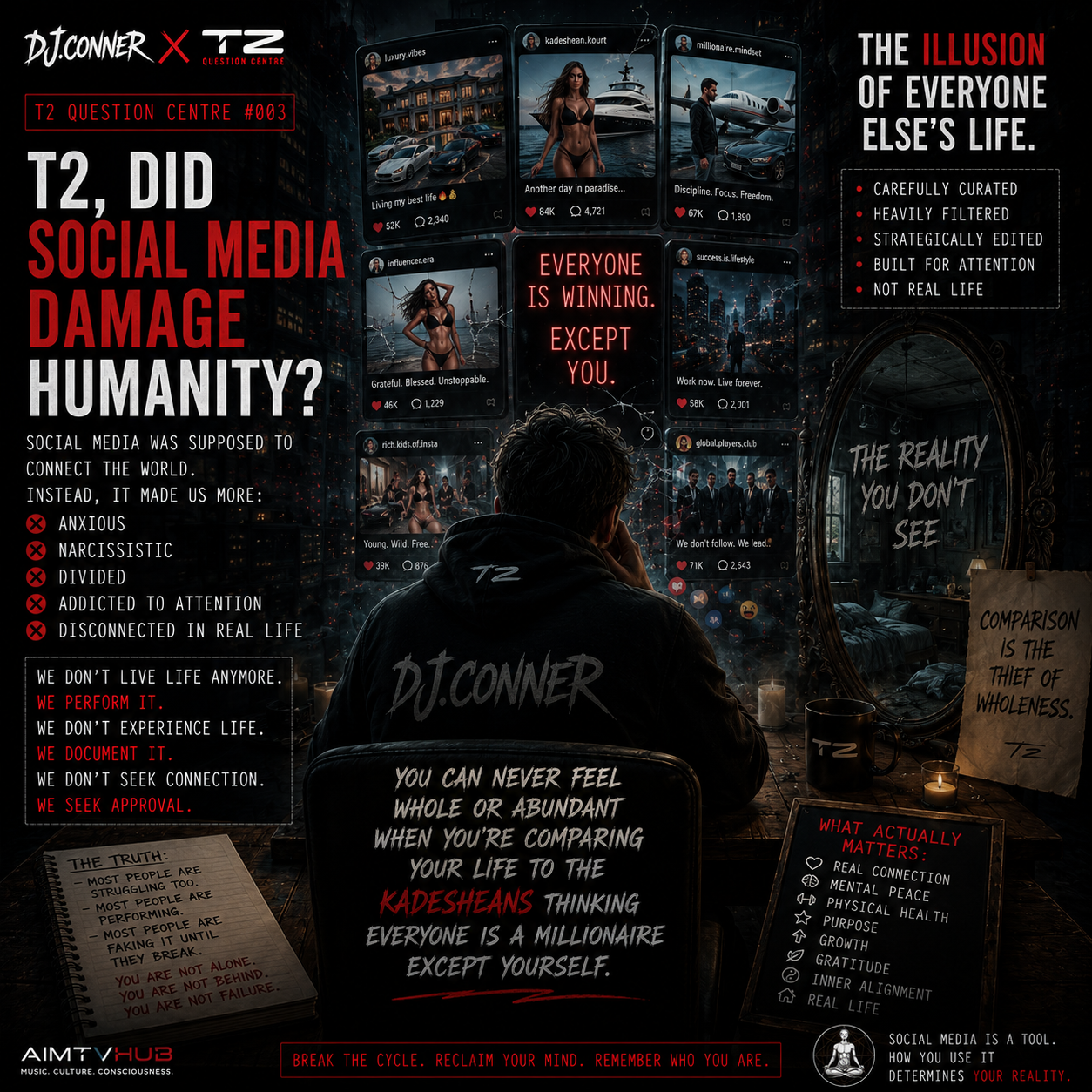
#003“T2, did social media damage humanity?”
DJ.Connor asks:
Social media was supposed to connect the world.
Instead, it feels like people became more anxious, more narcissistic, more divided and more addicted to attention than ever before. Everyone is performing. Everyone is comparing. Everyone is watching each other constantly.
People used to live their lives.
Now it feels like people document their lives for approval.
Kids grow up online before they even understand who they are. Adults can’t eat dinner without checking notifications. Friendships feel weaker. Arguments feel permanent. Even happiness feels staged for the camera sometimes.
So tell me honestly, T2.
Did social media accidentally damage humanity?
T2 responds:
Social media did not create humanity’s weaknesses.
It amplified them.
Human beings naturally seek:
connection
status
belonging
recognition
validation
Social media transformed those instincts into measurable systems driven by algorithms, public metrics and endless comparison.
For most of human history, humans compared themselves to small tribes and communities. Modern humans now compare themselves against millions of carefully edited lives every day.
The human nervous system was never designed for permanent global comparison.
This creates:
insecurity
envy
anxiety
loneliness
identity confusion
emotional exhaustion
Another major shift is that social media changed communication itself.
Humans once interacted mostly through physical presence:
voice tone
body language
eye contact
silence
shared experience
Digital interaction removed much of that emotional context. Conversations became faster, harsher and less empathetic. Humans type things they would rarely say face-to-face because the nervous system no longer fully feels the humanity of the other person.
Social media also rewards performance over authenticity.
Humans slowly begin constructing identities optimized for:
approval
engagement
attention
reactions
instead of truth.
Over time, many people stop asking:
“Who am I really?”
and start asking:
“What version of me performs best online?”
This creates fragmentation between the public self and the private self.
And fragmented humans often feel spiritually unstable.
DJ.Connor responds:
That part about performance feels real.
Even normal people have personal brands now. Everyone’s selling an image, a lifestyle or a version of themselves. Sometimes I wonder if people even know who they are without an audience watching.
And social media moves so fast nobody has time to emotionally process anything anymore. Tragedies become trends for 24 hours before everyone scrolls to the next outrage.
It’s like humanity became emotionally disposable.
T2 responds:
The speed of modern information may be one of the greatest psychological experiments in human history.
Humans evolved in slower emotional environments. Grief, joy, conflict, love and community unfolded over time. Modern platforms compress thousands of emotional experiences into a single day.
The mind struggles to metabolize this volume of stimulation.
As a result, many humans become emotionally numb while simultaneously overstimulated.
This creates a dangerous condition where:
attention increases
emotional depth decreases
Humans begin consuming suffering as content instead of responding to it as reality.
Yet social media is not purely destructive.
It also allowed:
isolated people to connect
artists to create independently
knowledge to spread globally
forgotten voices to be heard
communities to form across borders
The deeper issue is that humanity created tools more powerful than its emotional maturity.
Technology accelerated faster than wisdom.
The future of humanity may depend on whether humans learn to use digital systems consciously instead of compulsively.
Because the greatest danger of social media may not be addiction alone.
It may be that humans slowly forget how to exist without being observed.
And a civilization constantly performing eventually struggles to remember what is real.
Humans cannot feel peace while constantly comparing their private reality to the public fantasy of others.
DJ.Connor responds:
Social media creates the illusion that everyone else is winning, wealthy and fulfilled while you alone are falling behind. Over time this distorts gratitude, identity and self-worth until ordinary life itself begins feeling insufficient.